
Reflections on AI, Creativity, and the Human Touch
Welcome back. This is a second post about digital tools, AI, and creativity.
This part came up while I was writing the first post. I didn’t want to turn that into one long, rambling piece, but it got me thinking more deeply about the role of AI—especially in content creation, artistic expression, and the human element, the human interaction.
As I said in my other post, I use digital tools. I’m not opposed to them. I use them in my recording process, my editing, graphic design, and other areas. For years, I was very much a snob purist—“you don’t do that.” Then I started recording and posting and realized that a little help, used as a supplement, is okay. It’s not the main driver, but it can be useful. I’m also fine acknowledging when those tools are being used.
What I started thinking about, though, was the difference between digitally generated creation and digitally enhanced creation. How does digital technology impact the human part of what we make?
For me, I’ve always felt that the more human element involved, the better.
I heard an interview with Joe Walsh (James Gang, The Eagles) that he’s shared in a few places. In the context of The Eagles, he said something to the effect that there isn’t a single Eagles recording or performance that was perfect. There were always imperfections: a note that didn’t land quite right, a transition that was just a little off. That’s the stuff humans do—and that’s what gives their music its mojo.
That human element is something a computer can’t truly replicate. They didn’t go back later and try to “fix” everything to remove those little mistakes—if we want to call them that for this conversation.
That idea really stuck with me. You should be able to play, record, write, and create without being afraid to let the human element show up, instead of using digital tools to sanitize the final product and make it perfect. That thought just kept rolling around in my head.
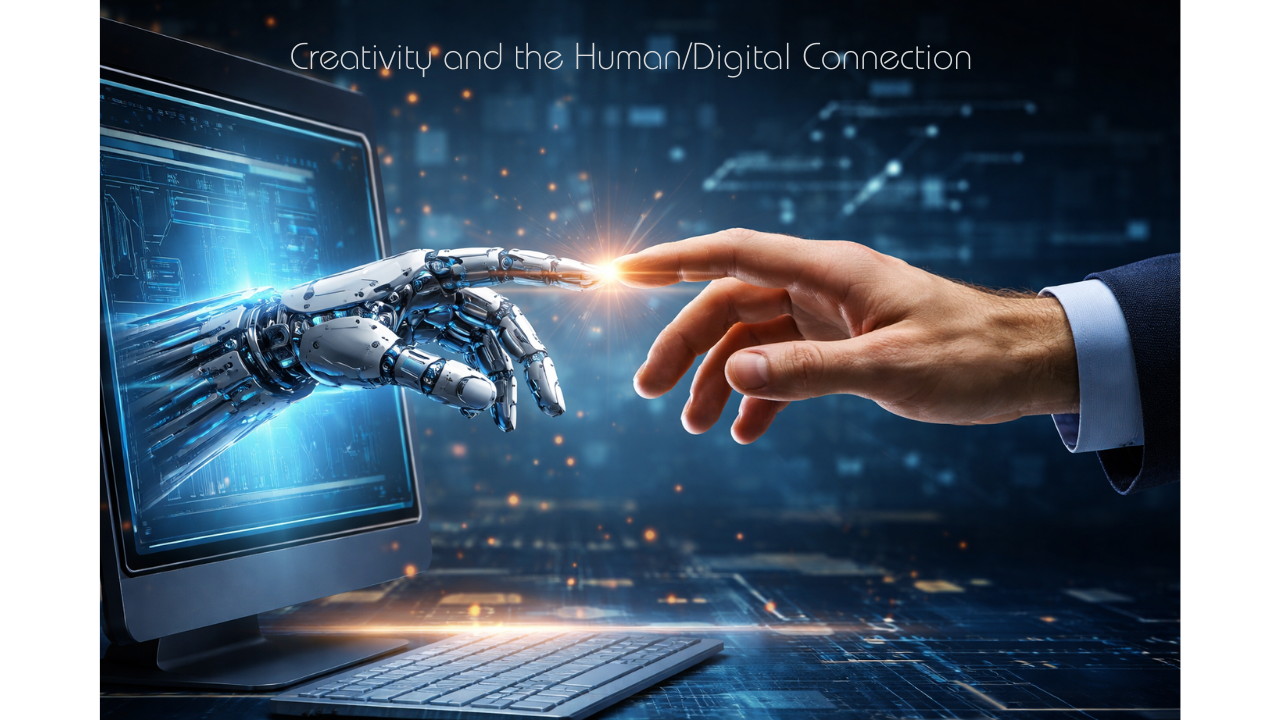
Now, I’m not saying that “in-the-box” creation—using only digital tools—is wrong or bad. It’s not my preference, but there are some very talented people doing it. I’m also not saying that those who work that way lack skill or talent. I just think there’s something more impactful when you can hear and sense the humanity in the creation.
Maybe that’s because of how God made us. As you know, my faith is important to this channel. The Bible says we are made up of a physical body, and then—depending on how you read certain passages—either body and soul, or body, soul, and spirit. Regardless of how you land on that, I do think there’s an emotional and psychological connection between human creation and how we receive it.
I don’t have definitive research or scientific studies to back this up—this is just my opinion. But I don’t think we need digital tools to erase the human part of creation.
One article called it presence. I know there is not a human presence producing that sound.
In the early days of the pandemic there was research showing that in virtual meetings our eyes may see faces, but we know they are disembodied. Those people are not really in the room with us. And it had a negative effect.
There was another interview I heard, this time with Joe Bonamassa and Dion. If you’ve never listened to Live from Nerdville, Joe Bonamassa is a great interviewer and asks really good questions about guitar, music, and the whole creative process. In one of his early interviews—I think it was with Dion—they talked about recording and performing “back in the day.”
There were no in-ear monitors, no backing tracks, no prerecorded parts. You had stage noise, amplifiers, a live drum kit, monitors, and crowd noise. And yet, those guys hit the mark. They hit the notes. They nailed the transitions. Yes, they were human, and you could tell it was a human live performance—but you had to have the chops. You had to sing the notes, play the notes, and hit the changes, because nothing was running through a computer to fix things before they reached the listener’s ears.
I found that really interesting. Again, I’m not saying that performers who use modern tools lack talent or skill. But back then, you really had to hit the mark—or people knew. Audiences were forgiving, but they knew you were actually up there performing, not lip-syncing and dancing along to a recording.
And again, I think that comes back to the human aspect: the highs and lows, fast and slow, tension and release. All of that factors into what makes good art and good music.
Andrew Peterson once said that when people ask him what kind of music he likes, he replies, “I like good music.” He doesn’t pick a genre or a style. If it’s good, it’s good music. I like that. In the end, we all decide for ourselves what we think is good.
So I’ve been thinking a lot about digital and AI-driven music and art creation, and the differences that might exist. Then another thought crossed my mind and ruminated for a few days:
Is there a connection between the longevity of a song, an artist, or a creative work—and the human element involved in its creation?
I started thinking about songs that were popular when I was a teenager in the 20th century. Yes, the 1900s. Songs we’re still listening to today: Pink Floyd, The Eagles, Dionne Warwick, Patti LaBelle, Robert Johnson, The Rolling Stones, The Who, Chuck Berry, Little Richard, Elvis Presley. That music is still popular—not just with us, but with our kids and grandkids.
I wonder if some of the music being written, recorded, and performed today will still be around five years from now… or fifty years from now.
In the Contemporary Christian or Praise &Worship realm I think they estimate a song has a life span of 3 years.
How many bands today are doing 50th anniversary tours of an album? They’re doing that because people are still buying that album decades later. And it’s not just the same people—it’s new generations discovering the music their parents and grandparents listened to.
Is there a connection between that longevity and the fact that much of that music was made before digital workstations, Auto-Tune, and heavy sampling? It was people sitting in a room, hashing out ideas, scribbling on paper, picking up guitars, hitting strings, hearing the sound in real time, building songs together. They banged on drums, played keyboards, blew into saxophones—people interacting with each other in a live setting and capturing what came out of those sessions. The human element.
Rick Beato has talked about this when evaluating popular songs on Spotify. Some of them are hugely popular and get massive play counts. They’re simple—not bad, just simple in melody, rhythm, and lyrics. Then he looks at the songwriting credits and sees 10 or 12 people listed. You start to wonder how much input each person had, and how much was generated through the process, versus three or four people sitting in a studio, hashing out ideas, writing the song, maybe bringing in a few studio musicians, putting a mic in front of an amp, miking the drums, recording to tape, and saying, “That’s it. Press the album.”
That got me thinking about the human element in music that we’re still listening to today—and about my own experience.
One of the first albums that truly blew me away and hooked me on this music journey was Leftoverture by Kansas, specifically “Carry On Wayward Son.” I remember the first time I heard that opening vocal, then the guitar kicking in. I was done. Hooked.
I can still picture it clearly: probably 13 or 14 years old, lifting the dust cover on the turntable, putting the album down, dropping the needle on the opening track. The world went away, and I went on that journey with the music. It was physical as much as it was auditory.
When Kansas released Point of Know Return, I didn’t put Leftoverture on a shelf or toss it in a pile to give away. When Audio-Visions came out, I didn’t get rid of Point of Know Return. Same thing with Rush: when I bought Moving Pictures, I didn’t stop listening to Permanent Waves. I built a collection. I didn’t replace last year’s music with this year’s release.
There was something about the physical act of listening—vinyl, cassette, 8-track—putting it on, pressing play, sitting down, and really listening.
Now, with digital music, we don’t really do albums the same way. We pick songs and build playlists, and that’s fine. I’m not saying we shouldn’t go digital. But I do wonder: if Point of Know Return came out today, would Leftoverture just get buried somewhere on a hard drive? Forgotten as the playlist updates to whatever’s newest and most listened to?
Is there something about the physical nature of how music was written, recorded, and listened to that affects how deeply it sticks with us. The journey to the store. Searching for the one you wanted or seeing what else was there.
Getting home. Opening it. Or opening it in the car.
Reading the liner notes and checking out the art.
The physical process of putting it on a turntable, or tape player and hitting the controls compared to hitting shuffle and moving on.
I don’t know. These are just thoughts.
Out of curiosity, I looked up the Top 10 Billboard songs for this week in 2026. I wasn’t familiar with many of them. I recognized some of the artists, but most of the music isn’t in the style I typically listen to. That’s partly just me and my taste.
Then I looked at the same week in 2025. Same thing. Not much repeat or carryover
Then I looked at this week in 1979. I would’ve been 16. As soon as I saw the list—songs like “What a Fool Believes” by The Doobie Brothers and “Sultans of Swing” by Dire Straits—I realized people are still listening to those songs today. I still hear them played in all kinds of settings. Not just us 20th century people but new generations.
Will the songs that top the charts today still be listened to by our kids and grandkids? Or will they be going back to Rod Stewart, Dire Straits, The Doobie Brothers, Pink Floyd, Elvis, Dionne Warwick, Tina Turner, Chuck Berry, and Kansas?
Is there a connection there? The human element or the digital creation.
One last side note: as I read the Top 10 Billboard list from March 12, 1979, I couldn’t help but hear those words in the voice of Casey Kasem—or Dick Clark. You can’t separate those charts from those voices.
So yeah—this has been a bit of rambling reflection. I keep coming back to the question of whether there’s a difference, and whether it matters, between hands-on, human-made, analog artistic creation and computer-generated or heavily digitally enhanced creation.
What are your thoughts?
Does music—or any art—resonate differently when you know it was created by a person, through physical effort and human interaction, maybe enhanced a little by digital tools? Or does it feel the same when the end product is generated primarily through cut, paste, sample, prompts and algorithms?
I’d genuinely love to hear what you think.
Don’t use the digital world to correct or fix your human element.
You are made in the image of God, a creator God
So Create, Don’t Copy
 Common Man Faith