
The Visitation — Luke 19
A large portion of the Christian church throughout the world is entering Passion Week—Holy Week. The word passion speaks of suffering. Today, we recognize Palm Sunday, which commemorates the triumphal entry of Jesus Christ into Jerusalem. He comes riding on a donkey, while crowds celebrate, laying palm branches before Him in welcome.
The crowds are not unfamiliar with Jesus. In the account given in Gospel of John, He has just been in Bethany, where He raised Lazarus from the dead. The news has spread. The people are aware that something significant is unfolding—and so is Jesus.
He had already instructed His disciples to find a donkey and prepare for His entry. Nothing here is accidental. He has chosen the day, the route, and even the manner of His arrival. He knows what awaits Him at every step.
The donkey is not incidental; it is deeply significant. It fulfills the prophecy found in Book of Zechariah 9:9:
“Rejoice greatly, O daughter of Zion!
Shout aloud, O daughter of Jerusalem!
Behold, your king is coming to you;
righteous and having salvation is he,
humble and mounted on a donkey,
on a colt, the foal of a donkey.”
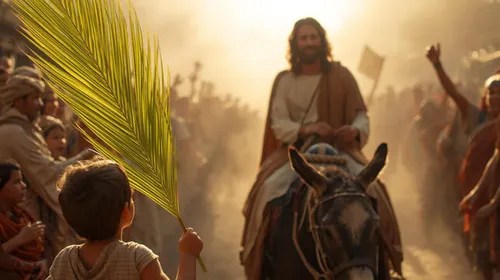
This was a royal image. In earlier times, even kings such as King David rode on mules. In that culture, the donkey was a symbol of dignity and kingship. Only later did the horse become the more common symbol of royal power.
Yet the emphasis of the prophecy is not merely on His mode of transportation, but on His character. He is humble. He is righteous. He is the King who always does what is right—the One without sin.
This humility is not what the people expected. It is not what they desired in a king or a deliverer. The term carries the sense of gentleness and peace. He did not come to overthrow the Roman Empire by force, but to reconcile sinners to God.
As John the Baptist declared, He is the Lamb of God who takes away the sin of the world. He Himself said that He came not to be served, but to serve, and to give His life as a ransom for many.
All of this unfolds according to divine purpose, in fulfillment of prophecy.
His position is that of a King.
His character is that of a humble peacemaker.
And we must remember: peace is not the overlooking of sin, of redefining what is wrong and right. Of doing whatever you want without consequence. It is the reconciliation of those who are estranged—in this case, between God and man.
He came as a King to serve His people and to accomplish what only He could accomplish.
As He entered the city, some responded rightly. They worshiped Him. They acknowledged His works. They recognized who He was—that He was sent from God and that He came to save. This is the meaning of “Hosanna.”
Yet alongside worship, there is opposition. Some demand that the crowds be silenced.
Jesus disrupts the status quo. He draws attention away from the religious rulers. He teaches with authority. He exposes sin. He gathers a following. In doing so, He threatens their position.
In a sense, this is their own “no king” rally. The King arrives, and rather than receive Him, they reject Him. Not only do they seek to silence Him—they will soon seek to kill Him.
And for what reason?
He healed the sick.
He raised the dead.
He spoke truth with authority.
He confronted sin.
Yet they do not want Him—not as He truly is. They want a savior on their own terms: one who affirms them without question, who leaves their sin unchallenged, who conforms to their expectations.
This passage reveals a sobering truth: people do not naturally recognize what is good, true, or right. What is good, even best for them.
We prefer our own way. We resist correction. We do not want to be confronted.
At the end of the passage in Gospel of Luke, Jesus weeps over Jerusalem, saying that they did not recognize “the day of your visitation.”
He is saying, in effect: You do not understand what is being offered to you. You are content with your own way, while I have come to bring you something far greater.
Earlier, in Gospel of Luke 4, Jesus began His ministry by declaring the fulfillment of Book of Isaiah 61:
“The Spirit of the Lord is upon me,
because he has anointed me
to proclaim good news to the poor…
liberty to the captives…
recovery of sight to the blind…
to set at liberty those who are oppressed,
to proclaim the year of the Lord’s favor.”
He declared, “Today this Scripture has been fulfilled.”
Now, at Palm Sunday, we see another prophesy, another visitation—another declaration of salvation, another proclamation of the Lord’s favor.
And yet, the response is rejection by some.
Jesus both begins and concludes His earthly ministry by pointing to the promises of the Old Testament—promises of salvation, restoration, and hope. And yet, He is rejected.
There remains another promised appearing—one not yet fulfilled.
Next time, He will not come on a donkey, but on a horse. He will come not in humility, but in final judgment, to establish His sovereign rule over all creation—the very world He made and came to redeem.
People do not always recognize what is best for them. We cling to our own position, even when we are wrong. As has been said, one may shout loudly and still be wrong at the top of your voice.
But for now, the offer remains.
There is still a call to return.
There is still an invitation to receive the favor of the Lord.
This is still a day of salvation.
As Epistle to the Hebrews warns, we must not neglect so great a salvation.
Jesus wept over the lostness, blindness, and confusion of His people. Yet He extended—and still extends—the call to come to Him.
And so the question remains:
Will I stand among those who seek to silence Him?
Will I join the crowd that cries, “Crucify Him”?
Or will I cry out, “Hosanna—blessed is He who comes in the name of the Lord”?
 Common Man Faith