
The Power of Light
Light has many uses. In fact, one source of light can do many things at once. It can reveal what is hidden, even the things we would rather keep in the dark. It can illuminate a path so that we can see clearly. And some forms of light even have the power to cleanse and disinfect.
Jesus calls Himself the light of the world.
Lately, I’ve been walking through the “I am” statements of Jesus in the Gospel of John. This time, I want to look at the places where Jesus says, “I am the light of the world.” He uses that phrase in John 8 and John 9, and in both passages, we see something different about what He means. As a reminder, all of these “I am” statements point back to Exodus 3, where God reveals His name to Moses as “I AM.”
The people who heard Jesus did not miss what He was claiming, even if we sometimes do. They understood that He was speaking with divine authority, identifying Himself with the God of the Old Testament. In other words, Jesus was making Himself one with the Lord who had revealed Himself to Israel.
Jesus’ main claim is simple and profound: He is the light of the world, and those who follow Him will not walk in darkness but will have the light of life. And while the light is with us, there is work to do.
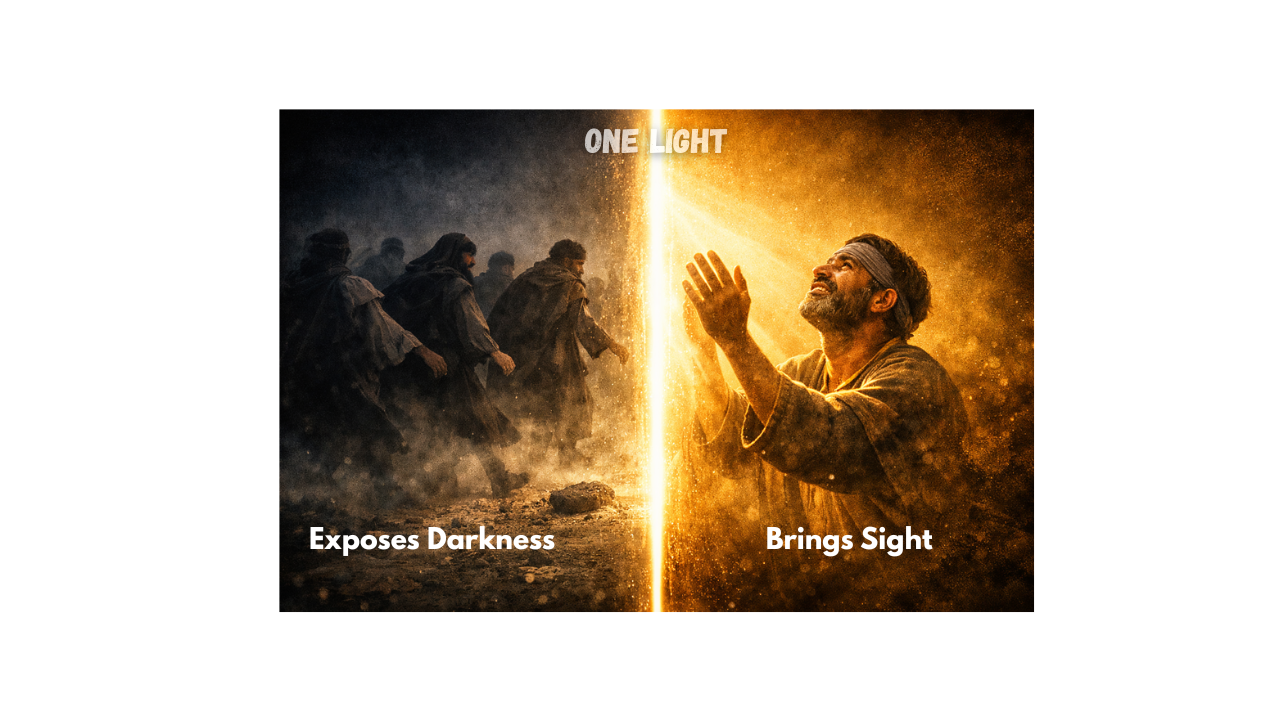
Jesus also draws a sharp contrast between light and darkness. He shows us that those who walk in darkness or in light are not always who they appear to be. Even Satan and his servants can masquerade as angels of light. They do not appear as the evil, lying, murderous beings they truly are.
John 8 begins with the woman caught in adultery. Yet as Jesus exposes the darkness, what comes into view is not only her sin but the sin of her accusers.
As Jesus writes in the sand, the religious leaders—the supposedly righteous ones—leave one by one. We do not know what He wrote. Perhaps He listed their sins. Perhaps He exposed their hypocrisy. Whatever He wrote, the effect was unmistakable: light had entered the scene, and darkness could not endure it.
Light dispels darkness.
Darkness hates being exposed.
Here, the real issue was not only the woman’s sin, but the Pharisees’ hypocrisy and their refusal to recognize who Jesus is. Jesus did not condemn her, but He also did not condone her sin. He sent her away with these gracious words: “Go, and sin no more.”
So yes, several sins are exposed in this passage. One sinner came into the light and left restored by the Savior. Others left, still determined to destroy Him.
In fact, they would rather kill Jesus than surrender to the light. They wanted to extinguish the light so they could remain in darkness. That is the work of the enemy. He works to snuff out the light at any cost. And in that, it becomes clear that their father is not the Father of heaven, the Father of lights.
The Pharisees respond as though Jesus is speaking on His own and expecting them simply to take His word for it. But Jesus says, “My Father bears witness of Me.” In other words, everything they had seen in Him was already God’s testimony confirming who He is.
Jesus then says plainly that they do not know the Father. In fact, He tells them they will die in their sins because they have rejected the One the Father sent and affirmed.
The rest of the passage makes His claim even clearer. Jesus is the One sent by the Father, the promised descendant of Abraham. The Pharisees claimed Abraham as their father, but their deeds exposed the darkness they lived in.
“If God were your Father,” Jesus says, “you would love Me, for I came from Him and He sent Me.”
Then, in John 9, we meet a blind man. Once again, the religious leaders want to extinguish the light, so they ask, “Who sinned, this man or his parents?” They had a very rigid way of thinking: if someone was blind, then someone must have done something wrong. They could not imagine that God might be doing something far greater.
Jesus has just claimed divine identity. He has tied His authority to Abraham and beyond. And now He performs a miracle to confirm that claim.
The leaders also claimed descent from Abraham, but apart from physical lineage there was little in them that reflected Abraham’s faith. They had missed the point.
So first, the light causes the children of darkness to flee.
Then, in John 9, the light brings healing and sight.
Even when the Pharisees question the man, they refuse to acknowledge what Jesus has done. They insist that he must not really have been blind. They claim to be disciples of Moses, whose God spoke to him, yet when confronted with the work of Jesus, they say, “We do not know this Jesus.”
The blind man responds with striking clarity: why all the confusion? How can they deny what has happened? He knows he was blind, and now he sees. So instead of rejoicing, they call him a sinner, insist he was blind because he deserved it, and cast him out.
Again, as the light exposes their sin, they try to push the light away.
Jesus exposes sin in one group and brings sight to another.
The difference is this: what do we do with the light of the world? What do we do with the word of God revealed in Scripture?
Do we ignore it and remain in darkness, or do we embrace it and receive sight?
Do we remain blind, or do we allow God to show us His way?
A quick caution: I am not talking about some mystical inner light, or some spiritual power we generate within ourselves. I am using the phrase the way Jesus uses it. Jesus Himself is the light who exposes, cleanses, and heals. This is not something we achieve from within. It is who He is and what He does.
Two challenges to Jesus. Two attempts to trip Him up or expose Him as a fraud. And two times Jesus calls Himself the light of the world—exposing sin and bringing healing, both spiritual and physical.
So here is the choice before us. God has revealed Himself in the past, and He has revealed Himself fully in Jesus Christ. And we still face that same choice today.
There are those who see the evidence and, when the light shines, allow it to expose them. They let that light bring healing and life.
And there are those who try to turn the light off, accuse it, or deny it, because they would rather remain in darkness than let the light of the world bring them life.
 Common Man Faith