
Remember Monty Hall and Let’s Make a Deal—now hosted by Wayne Brady. In the end, after all the wheeling and dealing, the contestant was given one final choice: three doors. Behind one of them might be something better, even life-changing. You had a 33% chance of something better and a 66% chance of losing out
But what if I told you there is a door you may enter that leads to abundant life, and it requires no bargaining, no gambling, and no negotiation at all? It is a 100% guarantees for anyone who enters this door
In John 10 Jesus calls Himself the door. Just before John 10, in John 9, a group of religious leaders cast out a man from their assembly—effectively excommunicating him. Why? Because the man who had once been blind now could see, and he gave Jesus the credit. The leaders would not tolerate that testimony. They claimed to be shepherds of God’s people, but in truth they were failing the flock.
That is the backdrop for Jesus’ words in John 10. He is exposing false shepherds—those who appear to care for the sheep but who, in reality, are false shepherds. Like the leaders who drove out the man healed by Christ, they show themselves to be hostile to the very work of God.
Jesus says that true shepherds are those who come through the door by His calling. Some who claim to be shepherds are not entering rightly. They are thieves and robbers, coming by another way. They have not been called by Christ, but have instead taken a place that was never theirs.
Now I know there are many men who are faithful pastors and elders who are serving Christ’s church with humility, integrity, and sincerity. The Lord has truly called and blessed them in their work. But there are also many who stand in pulpits without having been called by Christ in the manner His Word requires. Some have misunderstood the qualifications for pastoral office. Others have set those qualifications aside to fit the spirit of the age or their own personal preference.
And while God may still bless His Word when it is preached, that does not mean a person is free to claim a role Christ never gave him. A person may see fruit in ministry and yet still act outside the bounds of God’s calling. It is a solemn thing to serve in a way that seems fruitful, yet is not obedient.
There is an account as Moses lead the people to the promised land where the people complain they are thirsty. God tells Moses to speak to the rock and water will come forth. Moses, for whatever reason, strikes the rock. Now water did come out, but Moses would forfeit the blessing of entering the promised land with the people he was leading.
You see, God still blessed as He said He would. But Moses, because he chose to do it his way and not God’s forfeited a blessing.
Someone can be in a pulpit, teaching accurately the word of God. So God will bless His word and the hearer, but not the preacher.
There may be many people who think they are doing right, in their own opinion, but if it does not align with God’s word there is a forfeited blessing.
In the end God can bless His word, because that is where the power is, His Word and His Spirit even while withholding a blessing for the speaker
Jesus then presents Himself not only as the One who protects the sheep, but as the door of the sheep. That is the point I want to focus on now: “I am the door.”
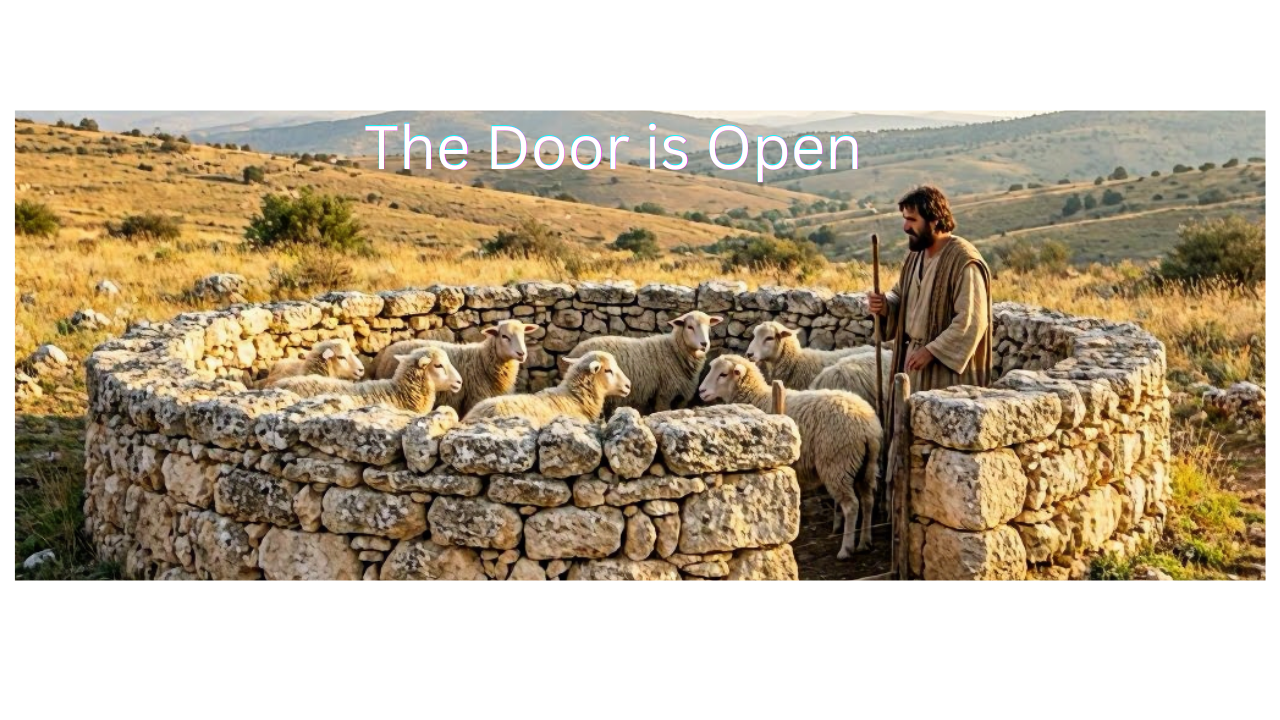
A typical sheepfold in the countryside was a simple structure, often just a rough wall of stones forming a pen with one opening. At night, the shepherd would lie across that opening, becoming the gate himself. In that way, he protected the sheep from wild animals and from thieves. The sheep were safe because the shepherd stood watch.
What do we learn about Jesus when He calls Himself The Door?
First, there is only one door. That means there is only one way to God, and that way is Jesus Christ. The sheepfold had one entrance, not many. The same is true for salvation. Christ does not present Himself as one option among several. He is the only way.
Those who enter this door will be saved and come in and out and find pasture
How can Jesus make such a claim? If He were merely a man, the claim would indeed be absurd. But if He is who He said He is—the eternal Son of God, incarnate for our salvation—then His words are not arrogance; they are truth.
He came into the world to seek and save the lost. And we are all lost. We deserve death for our sin, both physically and spiritually. We deserve separation from God. But Christ, though sinless, took our guilt upon Himself and died in our place. No one else could do this. No one else was qualified. No one else was needed. He alone is the door by which sinners come to the Father.
Second, Jesus teaches that we must enter in. This is personal. It is not enough to admire the door, talk about the door, or stand near the door. One must enter through it. In Scripture, this is the language of faith—coming to Christ, trusting Christ, believing on Christ. Salvation is not inherited, borrowed, or approximated. It is received personally by faith.
And what are the promises of entering this door?
First, Jesus says that whoever enters will be saved. That is a glorious promise. The Savior does not say the path will be easy, or that the sheep will never face danger. But He does promise salvation.
Second, His sheep are safe. They may still walk through valleys, but they do so under His watchful care. He provides for them. He guards them. He keeps them.
Third, His sheep are satisfied. They go in and out and find pasture. They find green grass and still waters. In Christ, the believer finds not only security, but rest for the soul.
This is why the door matters so much. It tells us how we enter God’s presence. Sin has separated us from God, but Christ has opened the way. Through His death, burial, and resurrection, He has made access possible. When Jesus died, the temple curtain was torn, showing that the barrier between God and man had been opened by divine grace. Christ has established that access Himself.
So there are two ideas in Jesus as the Door. He determines and calls those who will be shepherds according to His call, and He is the only way into this flock.
And notice the wording: Jesus does not say He is a door, but the door. That definite article matters. It excludes all alternatives. There are not many doors leading to God. There is one.
This is the invitation of the gospel. The door stands open, and by faith in the Son of God we enter in.
This door is not there to keep people out. The door is not there to separate us from God. It is open to receiving sinners. Yet one day it will be shut. But for now, the door remains open, and the call of Christ still goes out.
There may seem to be many ways into God’s favor, but Scripture is clear: there is one door. We do not choose from among three. We do not bargain our way in. We do not win access by cleverness, effort, or religious performance.
No deal must be struck. No costume must be worn to get the host’s attention. Jesus says, “Come to Me.” He is the door, and access to God is open to all who come in faith.
The only thing we have to offer in trade is our sin. That is the promise. When we bring our sin to the Savior, He paid the punishment for our sin and then escorts us through the door into the abundant life God promises.
More on the Shephard next time.
If you have been encouraged like, share and subscribe.
And leave a comment. Have you come through the door, and if not would you like to?

