
Getting His Sheep Home Safely
In these last few posts I’ve been spending time in Jesus’ “I Am” statements recorded in the Gospel of John.
I started in Exodus 3, where God reveals himself to Moses as “I AM.” The God who is—who depends on no one, and who keeps his promises. And then, in the Gospel of John, Jesus uses that name to describe Himself that is both personal and unmistakably divine.
His hearers knew what He was claiming. And I want to continue with the next I am statement.
We began with, “I am the bread of life.”
And what I’ve noticed is that the next few I am statements don’t just sit side-by-side—they build on each other.
Jesus says, “I am the light of the world.” And you remember what happens there: a man who was born blind receives his sight. The leaders of his synagogue then question him about it. But instead of rejoicing, they question if he was every really blind. Then they throw him out for speaking up about Jesus.
That’s where I said light does at least two things. It illuminates—because when God gives someone eyes to see, they’re drawn to Christ. And it exposes. And when light exposes what’s hidden, it can stir up resistance in people who don’t want their deeds brought into the open.
Then we looked at Jesus’ words, “I am the door.” And again, there are a couple of layers.
First, Jesus is the only entrance into the flock of God. There isn’t another door. There isn’t a side entrance. We don’t climb in by our own effort. If we come to God at all, we come through Christ.
Second, he’s the rightful gatekeeper—the one who admits true shepherds and exposes impostors. So the “light” and the “door” go together. Jesus is saying, in effect, “These leaders aren’t shepherding God’s people in God’s way.” The light exposed their own blindness. And now Jesus says you were never really true shepherds.
Now, that’s not just an issue back then. It’s an issue now.
There are many faithful men today who truly shepherd Christ’s people in humility, sacrifice and faithfulness, And we should thank God for them.
But there are also false shepherds. Some are blatant—lying, manipulating, using Scripture like a tool to get what they want. They twist the Word, distort it, and sometimes deny it outright. Much like Satan in the wilderness the actually question did God really say that while offering their own spin.
And sometimes it’s less obvious. There can be kind, sincere people who carry the title “shepherd,” but they were never called, and they don’t meet the biblical qualifications for the pastoral office. And I want to say this carefully: sincerity isn’t the test. Effort isn’t the test. Even gifting isn’t the final test. The question is, “Has Christ called this man to this office, and does his life meet the requirements God gives?” You can have shepherd like gifts, but that does not mean you are called to the office or position.
Scripture puts guardrails around the pastorate. The pastoral office is received, not seized. The Good Shepherd calls and sets apart under-shepherds, and he does it with clear qualifications—read 1 Timothy 3 and Titus 1.
And that sets us up for the next “I Am.” Jesus says, “I am the Good Shepherd.” And then He gives a mark that no pretender can fake: “The good shepherd lays down his life for the sheep.”
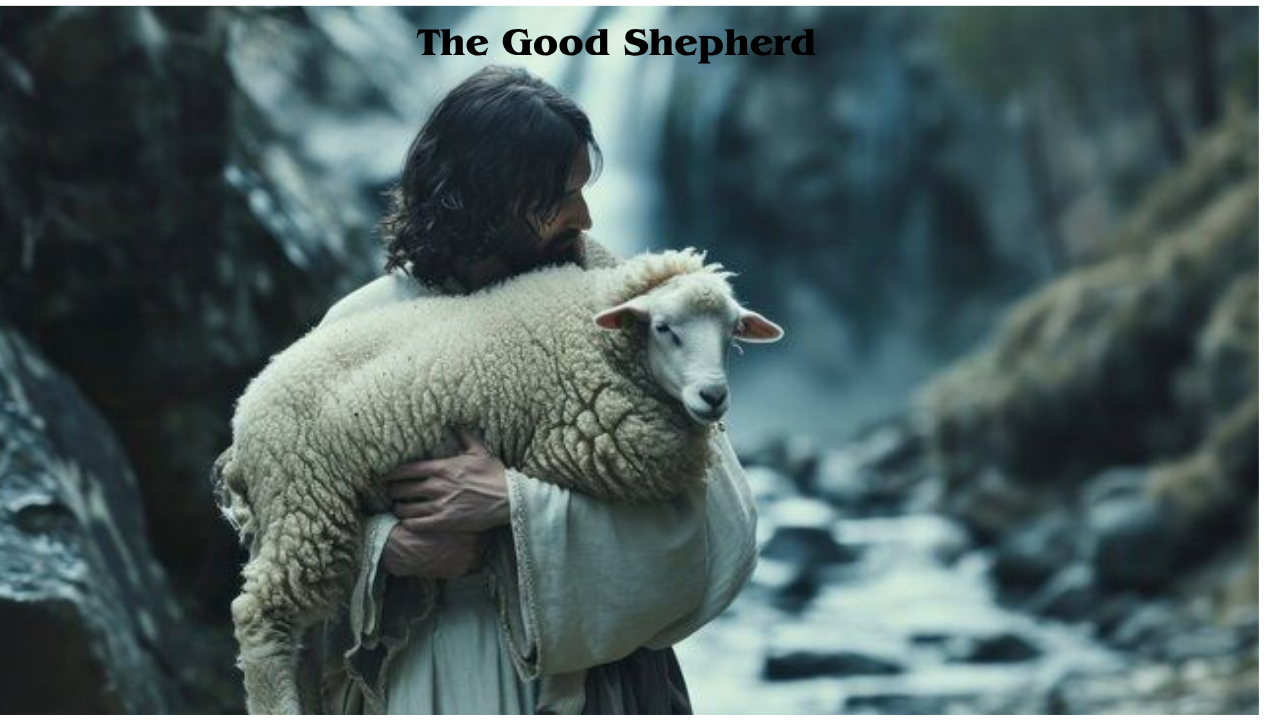
False shepherds take from the flock. They use the sheep. They harm the sheep. Some even “protect” their system by throwing out the person who simply tells the truth about Jesus.
But the Good Shepherd does the opposite. He gives Himself for the flock.
Now, when you hear “shepherd,” where does your mind go? For a lot of us it’s either the Christmas story—or Psalm 23.
Shepherding in the ancient world had a rhythm. In the morning the shepherd would call, and the flock would follow. During the day he watched them as they grazed, keeping an eye out for strays. He led them to water. And at night he brought them back in and counted them as they entered.
It was hard work. Heat and cold. Long days. Limited food. Predators. Robbers. That’s why shepherds carried a rod and a staff—tools for protection and for guidance.
And a good shepherd had to know the land—where the safe paths were, where the danger was, where the still water and green pastures were. Shepherding wasn’t only physical strength; it was wisdom.
And it required tenderness too, especially with the young and the weak.
Psalm 23 and John 10
Psalm 23 starts like this: “The LORD is my shepherd; I shall not want.” In other words, “Because He’s my Shepherd, I won’t lack what I truly need.” And in John 10, Jesus says the shepherd leads his sheep in and out. He knows them—and they know his voice.
“He restores my soul… for his name’s sake.” Here’s a simple way to think about that: the shepherd’s name is tied to the sheep’s condition. If the flock is neglected, everybody knows it. So the shepherd acts—for their good, and for his name, his reputation.
Then comes that line we all know: “Even though I walk through the valley of the shadow of death…” Notice—Psalm 23 doesn’t pretend the valleys aren’t real. And Jesus doesn’t pretend either. In John 10 he talks about thieves and robbers, about danger at the edges, even danger that tries to slip into the flock.
So yes—it’s dangerous out there. But here’s the comfort: Jesus says He goes before us. He’s with us in the difficulty. And He is committed to bringing His sheep all the way home.
“Your rod and your staff, they comfort me.” Those are tools of guidance and discipline. Because sheep wander. And honestly—so do we. Thieves and robbers aren’t our only threat. Our own selfishness and sinful desires and temptations are always close. We drift. We stumble. We fall.
So the shepherd uses the rod not only to fight off an enemy, but also to correct and recover the sheep. Sometimes correction feels severe—but it’s mercy. It’s the Shepherd refusing to let his sheep destroy themselves. And he doesn’t discipline from a distance. He stays near. He tends. He restores.
It is said that a shepherd if he has a stubborn sheep that keeps straying, will use the rod to break it’s leg. But he does not leave the sheep to suffer the consequences. He then carries the sheep until it is strengthened and has learned its lesson
The rod could also be used to part the wool and inspect for injury or infestation—careful attention the sheep can’t give itself.
Psalm 23 says, “You anoint my head with oil.” Picture the Shepherd applying what heals and soothes—like balm for irritated skin under dirty, matted wool.
And the staff wasn’t just a walking stick. It could pull a sheep back from a ledge, guide it back onto the path, or lift it out when it had fallen.
That’s the Shepherd’s care: protecting, correcting, watching over, and providing—often in the very places where danger is real.
Jesus says the one who follows Him “will be saved and will go in and out and find pasture”… and then he says, “I came that they may have life and have it abundantly.”[1]
And, “You prepare a table before me.” Even with enemies nearby—threats at the edges—the Shepherd is present. And He provides. He does not run off and leave us to fend for ourselves.
So when Psalm 23 says, “Surely goodness and mercy shall follow me all the days of my life,” it’s not wishful thinking. It’s the promise that the Shepherd’s care doesn’t run out.
“Goodness” means God is working for our good—our real wellbeing.
And “mercy” is his covenant kindness—steadfast love, faithfulness, the kind of love that doesn’t quit.
Now, here’s the heart of it. Jesus, the Good Shepherd, gives His life to protect His sheep—from sin, from judgment, and from death. He didn’t die only to show us what love looks like. He died because the danger is real, and because God is holy.
Sin separates us from the Holy God. And we don’t come through the Door on our own merit or qualifications. We need a Shepherd who comes after us—who finds us, guides us, and when we’re too weak, carries us. And the Door He opens is the Door He is.
He was willing and able to lay down his life for the sheep—and to take it up again. He rose from the dead. And right now, he is leading his people home: to the house of the Lord, where we will dwell forever.
He died in our place. And by his death, we are saved.[2]
So if Jesus is the Good Shepherd, what do you do? It’s wonderfully simple: follow him. Don’t go looking for another shepherd. Don’t wander off into the dark, thinking you’ll find better pasture somewhere else. In him you have what you truly need.
When you’re tired, he brings you to rest. When you’re thirsty, he leads you to living water. When you’re unsure, he guides you in paths of righteousness. When you’re afraid, he doesn’t shout from far away—he is with you. Follow the Good Shepherd. And as you follow him, goodness and mercy will follow you all the days of your life. And in his time, he will bring you to his house, where you will dwell with him forever.[3]
 Common Man Faith