
“I am the Resurrection and the Life” Jesus Christ
John 11 is a familiar story. Jesus receives word that His friend Lazarus is sick. But instead of rushing to his side, Jesus waits. He tells His disciples, “This illness does not lead to death.”
Two days later, the announcement comes: Lazarus has died. What is happening here?
Mary and Martha likely never heard Jesus’ earlier statement, but the disciples did. They must have wondered, “How can You say this won’t end in death… and now he’s dead?”
Then Jesus decides to go to Bethany, to the home of Mary and Martha. The disciples are concerned—Jerusalem’s authorities are looking for Jesus, and returning puts them all at risk. Jesus tells them, “Lazarus has fallen asleep, and I am going to wake him.”
The disciples misunderstand: “If he’s asleep, he’ll recover. Why risk danger?” So Jesus speaks plainly: “Lazarus has died, and for your sake I am glad I was not there, so that you may believe.”
When Jesus arrives, Mary and Martha are understandably heartbroken and confused. Martha meets Him first: “Lord, if You had been here, my brother would not have died. But even now I know that whatever You ask from God, God will give You.”
Jesus replies, “Your brother will rise again.” As faithful Jews, they believed in the future resurrection at the end of the age. But Jesus says something far more personal and astonishing:
“I am the resurrection and the life. Whoever believes in Me, though he die, yet shall he live; and everyone who lives and believes in Me shall never die. Do you believe this?”
Martha answers with a confession that echoes Peter’s in Matthew 16: “Yes, Lord; I believe that You are the Christ, the Son of God, who is coming into the world.”
Mary comes next, with the same grief, the same question, and Jesus weeps with her. Then He goes to the tomb. Most assume He is there to mourn. But Jesus reminds Martha: “Did I not tell you that if you believed you would see the glory of God?”
Here it is—the very thing He told His disciples, the truth He is revealing to Mary and Martha:
I am not late. This is not the end of the story. This is not a hopeless situation.
This moment is another demonstration that Jesus is the great “I AM,” the living God in the flesh. Nothing is too hard for Him.
He calls Lazarus by name. The stone is rolled away. And Lazarus walks out alive.
I wonder if this is why Jesus waited four days. If He had come sooner, people might have claimed Lazarus was unconscious or in a coma. But four days meant the community had declared him dead, wrapped him in grave clothes, and sealed him in the tomb. There was no doubt. Death had done its work.
So what is going on here? A few things to notice:
1. Jesus delays not out of indifference, but purpose.
He knew exactly what was happening. He knew what He would do. And He knew this miracle would validate His claims as the Christ, the Son of the living God.
2. Jesus is the life.
He is the source of life—from the womb to the tomb. Every human life is an act of God. To take innocent life is to rebel against the Creator and to harm an image‑bearer of God. (Here we are not discussing self‑defense, just war, or capital punishment—only the willful taking of innocent life.)
All life is in God’s hands. For the womb to the tomb life is the work of God and a gift of God.
3. What is resurrection?
I want to speak of resurrection in two ways.
A. The final resurrection.
At the end of the age, all humanity will be raised—some to everlasting life, others to everlasting judgment. On that day, God will not ask how many good deeds you did, how moral you were compared to your neighbor, or whether you were baptized, confirmed, or catechized. Those things matter, but they do not save.
The only question is this: Is your name written in the Book of Life? Have you been born again?
B. The spiritual resurrection.
Ephesians 2 says:
Ephesians 2 says And you were dead in the trespasses and sins 2 in which you once walked, following the course of this world, following the prince of the power of the air, the spirit that is now at work in the sons of disobedience— 3 among whom we all once lived in the passions of our flesh, carrying out the desires of the flesh and the mind, and were by nature children of wrath, like the rest of mankind[1]
I was dead. You were dead. Maybe you still are. Like the rest of all mankind, we are all born in sin and the language the bible uses is dead. Not sick, not weak, not broken. You are, I was dead.
You don’t need to reform your ways, adopt a resolution or intention or adopt some new moral behavior.
Not sick. Not weak. Not morally struggling. You are not broken. You are Dead. That is the language God uses to describe us.
Dead people do not revive themselves. They need someone from outside to intervene and give life.
No dead person ever performed CPR on themselves. Their only hope was an outside agency intervened. And for the spiritually dead we do not revive ourselves. We need someone from outside of ourself that can give life.
You may not feel dead. You woke up, you went about your day, maybe even went to church. But a corpse doesn’t feel the weight of 200 pounds placed on it. It feels nothing—because it is dead.
Spiritually, apart from Christ, we are the same. We do not feel the weight of our sin because we are spiritually lifeless.
But then come two of the most hope‑filled words in all of Scripture:
“But God…”
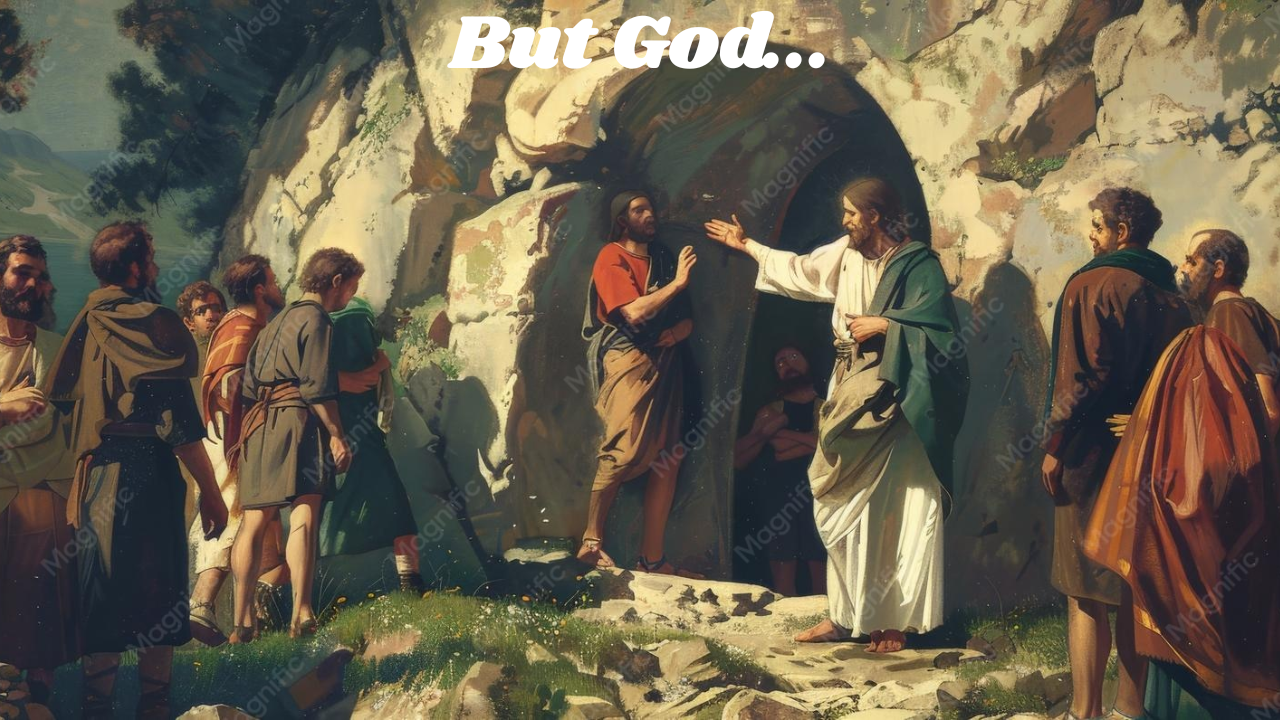
Lazarus is dead—but God. You were dead—but God.
You are dead, but God being rich in mercy, because of the great love with which he loved us, 5 even when we were dead in our trespasses, made us alive together with Christ—by grace you have been saved— 6 and raised us up with him and seated us with him in the heavenly places in Christ Jesus, 7 so that in the coming ages he might show the immeasurable riches of his grace in kindness toward us in Christ Jesus. 8 For by grace you have been saved through faith. And this is not your own doing; it is the gift of God, 9 not a result of works, so that no one may boast[2]
Did you hear that? When you were dead, God made you alive. He raised you up. He seated you with Christ. He considers you already home.
This is the gospel. This is the message of the Bible.
We enter the world spiritually dead, separated from God. Every day He gives us is an act of mercy—a chance to taste His goodness, to receive His grace, to be made alive.
4. God’s immeasurable grace.
What is this grace?
You were dead in sin. You rebelled against Him. You ignored Him. And He alone can make you alive.
Politics cannot do that. Money cannot do that. Education, science, and medicine—good as they are—cannot create life or resurrect the dead.
Only God can. And He is willing. And He is able.
Jesus is the resurrection. He has conquered death. He is life—the very source of our life.
I do not know why God seems to delay. But His delays are only delays from our perspective, not His. He knows the end from the beginning and every moment in between.
And He is the One who shows up at the right time—every time—to reveal Himself as the source of life and the Lord of resurrection.
The Bible describes our condition with three devastating words: “You were dead.”
But then come two of the most hope‑filled words in all of Scripture:
“But God…”
But God, rich in mercy.
But God, great in love.
But God, making the dead alive.
You cannot save yourself. Your works cannot save you. Your goodness cannot save you. Only Christ can. And He offers Himself freely—His life for your death, His righteousness for your sin, His resurrection for your grave.
If today you hear His voice, do not harden your heart. Turn to Him. Trust Him. Rest in Him.
He is the resurrection and the life—and He delights to save.
[1] The Holy Bible: English Standard Version (Eph 2:1–3). (2025). Crossway Bibles.
[2] The Holy Bible: English Standard Version (Eph 2:4–9). (2025). Crossway Bibles.

