Not Just Music

Gather God's People: Understand, Plan, and Lead Worship in Your Local Church (Practical Shepherding Series)Gather God’s People: Understand, Plan, and Lead Worship in Your Local Church by Brian Croft

My rating: 4 of 5 stars

Very good, and easy read. This book is a beneficial tool for those responsible to plan and lead worship. The authors begin with a solid biblical foundation of worship. This is not a book about style and technique but a call to maintain a biblical framework of worship. This is also not a book about music or music styles. The authors remind us that Biblical worship goes beyond music and includes 4 elements, Reading of Scripture, Praying Scripture, Preaching Scripture and Singing Scripture.

The authors then lay out some practical steps to plan each of these aspects of a church gathering. There are also reminders of what make a good worship leader. These qualities have nothing to do with charisma but having confidence in the word of God and the authority of the church and its leadership.

Yes there is the reminder that care must be taken in the public reading and praying yet leaders must be first convinced of the power of God’s word and the leaders responsibility to shepherd the flock not satisfy his own whims.

I would recommend this book for Pastors, Elder teams and worship teams, even youth and camp leaders and anyone else who are responsible to plan and lead a worship gathering and wants it to be more than a performance or concert.

View all my reviews

Posted in Review | Leave a comment

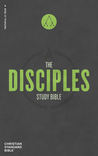
The Disciples Study Bible

CSB Disciple's Study Bible, HardcoverCSB Disciple’s Study Bible, Hardcover by Anonymous

My rating: 4 of 5 stars

The Disciples Study Bible from Broadman and Holman is another in a growing line of Study Bibles. This bible is built around the Christian Standard Bible and as such that makes it an accurate, readable, and accessible translation. There is quite a bit to commend about this Bible.

Each book has an introduction giving its basic purpose, background, and context. These intros give just enough information to be helpful without turning into a commentary. A plus to the introduction is the included timeline to see the books context in its historical setting. It should be noted that not all books contain introductions. Instead the introduction of a book may be tied to a related book. For example, the introduction for Nehemiah is included in the introduction to Ezra.

First are the notes. The notes in this version are plentiful. In some instances the notes take up more page space then the Biblical text. Instead of being a series of random notes tied to verses, the notes are built around various doctrines. Each note is identified in bold text to identify its doctrinal topic. For instance, notes may be categorized on prayer, Christian Ethics, Last Days etc. I found this to be a refreshing method so that instead of random notes interspersed throughout the text all the notes are tied to specific themes. The notes do follow a conservative, evangelical viewpoint but are not lopsided. The content is solid and beneficial.

This Bible has been designed primarily as a tool for discipleship and its offerings are specific to that task.

The first portion contains an explanation of the F260 method. This is a plan to read through the Bible in 260 readings. The idea is that instead of reading the entire Bible it is broken into a meta narrative of 260 readings. These readings cover chronologically the major points of the Bible as stated in the explanation. There is a page for each reading placed within the Biblical text to guide the reader. Each reading has prompts to guide the reader through HEAR. Highlight a specific verse in the reading. Explain the passage. Apply the passage. Respond to the passage. This is a useful guide to enable the reader to study and work through the passage on their own.

If I have one issue with the F260 is the amount of Scripture left out. For example, in this plan you only read Job 1, 2, 38-42. In Revelation you only read 1-5 & 18-22. 1&2 Chronicles are omitted. I do think this plan helps this Study Bible achieve its goal of helping a reader (new believer or new to discipleship) develop the habit of reading and journaling. I wish there were an option to include the entire Scripture into daily readings.

There are more tools for discipleship in the back of the Bible. What I have noticed is the group that developed these tools (Replicate Ministries) likes acronyms.

There is an explanation of the CLOSER method of Bible study.
Communicate (Prayer)
Listen (Bible Study)
Obey
Store (Scripture Memory)
Evangelism
Renew (Journaling, using the HEAR method)

There are also resources for forming and sustaining discipleship groups including the elements that make a good discipleship group with the emphasis on group or community. Included are pointers to apply these methods to different settings (family, children, staff, men, women)

There is one more section describing the basis of a healthy group and another acronym, MARCS
Missional
Accountability
Reproducible
Communal
Scriptural

All in all I would recommend this Bible for group study. I do not think it will be your everyday carry to church Bible due to its size and as stated the notes take up more page space at times making it hard to be a reader’s bible. But to give to someone either as a new believer or someone new to discipleship this is a solid tool. I can see it giving the user a solid grasp of the Biblical narrative as well as tools to be able to study and learn on their own as well as part of a group.

A copy of this book was provided for review by the publisher.

View all my reviews

Posted in Uncategorized | Leave a comment

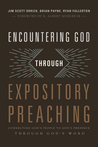
Encountering God Through Expository Preaching

Encountering God through Expository Preaching: Connecting God’s People to God’s Presence through God’s Word

Before I begin, let me give a quick introduction. I pastored various churches from 1987 until 2006, when I stepped away from Pastoral ministry. I remain very involved in a local church serving as a Worship Leader and Elder. I still have the privilege of preaching and teaching as the opportunity arises. As I continue to be exposed to solid preaching and preaching resources I feel like I owe my previous congregations an apology for some of my sermons.

I am interested in this book because of the opportunities I am given to preach and the desire to be a better preacher and listener. I also have seen a deficit in Biblical preaching. Mohler expresses this phenomenon in the introduction. He notes how the preaching of the word is being replaced by singing, drama, and other avenues of entertainment.

This book is not a “how to book” as much as it is a “why you should book”. There are plenty of practical sections on preparing a sermon, but the strength of the book is in its defense of expository preaching.

I appreciate that the opening section starts with the preacher’s qualifications and a review of Titus 2 and other appropriate passages. While not all who will preach are elders, any who are going to preach should still meet these qualifications. There is also a strong emphasis on reliance on the Holy Spirit in the preparation and delivery of sermons. Another plus.

The authors are also quick to note that preaching entire books is the better method. However, there are times to preach topically and that a topical message can be an expository message.

This volume is a fully Christ and word centered presentation. It is summed up in the phrase “preaching occurs when a holy man of God opens the word of God and says to the people of God, ‘Come and experience God with me in this text.’”

The book contains 3 sections. The authors start with The Man, The Text and The Spirit. This is the right place to start. This is the heart of the book starting with a strong foundation for the building of a sermon.

The authors do a great job stressing the importance of a passages context. The passage’s place in the whole of Scripture, the specific book and its place in the book must all be considered. After that the context of both the original and current hearer must be addressed. In fact, the illustration of The Wizard of Oz and historical context is worth getting this book.

It is not until this solid foundation is laid, do the authors move to the mechanics of sermon preparation

Here they move to the Early Preparation of the sermon. I am encouraged that the authors stressed the importance of the public reading of Scripture, an often-overlooked skill. This section also includes another strong reminder of the importance of context.

Finally, the authors move to delivery and the decision to use manuscripts, outlines or no notes. This section again includes a strong emphasis on diligent study and desperate reliance on the Holy Spirit. Their conclusion is that the preacher should work to the point of going without notes.

For me, the one part of the book that missed was the section on outlining. This chapter was another strong chapter on expository preaching but not as strong as the chapters on manuscripts or no notes.

In the end this book is not primarily about hermeneutics or sermon preparation even though those areas are covered. This is a solid, healthy defense of Expository preaching, something sorely missing in today’s church.

For those of you who regularly preach this is a good refresher on the importance of expository preaching. If you are just beginning start with this book and be convinced of the value of expository preaching, and then dig deeper to hone your skill. This way hopefully you won’t feel the need to apologize for questionable sermons.

NOTE: The publisher provided a copy of this book for review.

Posted in Uncategorized | Leave a comment

Review: H3 Leadership: Be Humble. Stay Hungry. Always Hustle.

H3 Leadership: Be Humble. Stay Hungry. Always Hustle.
H3 Leadership: Be Humble. Stay Hungry. Always Hustle. by Brad Lomenick
My rating: 3 of 5 stars

Brad has joined the list of those providing writing on leadership for a wide audience. I will say there was not a lot of new stuff here but that is OK. Not everything has to be new and novel. Tried and true are valid and Brad has been able to take the tried and true and present it for a new generation of leaders.

Brad works through each section of the “H’s” by laying a foundation followed by some practical steps to achieve each benchmark. Each chapter ends with what I believe is a unique and strong part of the book. Brad allows various other leaders to comment on practical points for each topic. These leaders range from Dan Rockwell (a leadership guru) to Kristen Stanfill (a worship leader). This drives the fact that these principles are far reaching and not just for business or church but can be widely applied.

My one negative was this. There seemed to be a lot of attention to Brad’s tenure and transitions with Catalyst. I would like to have had some more exposure to different settings. The ones provided at the end of each chapter were helpful but short. At times I felt like this was a journal of Brads success and transition with Catalyst.

If you are looking for new and novel this is not the book for you. If you are looking for different ways to see the tried and true applications at work go ahead and read this book.

View all my reviews

Posted in Uncategorized | Leave a comment

Review: Knowing Scripture

Knowing Scripture
Knowing Scripture by R.C. Sproul
My rating: 4 of 5 stars

Excellent book on how to read/study your Bible. This is a valuable resource to address an skill that seems widely missing in todays church. Too many of us are content to let someone else read and study and then tell us what the Scripture means.

Sproul does point out the church needs Pastors and teachers to expound Gods word for the church. They have been gifted and trained for this. Still this does not negate our responsibility to search the Scriptures ourselves as we seek to build a first hand relationship with Jesus Christ .

Sproul covers all the necessary areas including the motivation to study and the challenge to combat our own laziness for a fruit that lasts. He also covers the various types of writings in Scripture and the need to distinguish and interpret accordingly.

The book closes with a very helpful chapter explaining and recommending the various types of tools (both in print and digital) available for every skill and budget.

For those needing a positive motivation to study the Scriptures and the basic tools needed to get started, this book is a valuable resource

View all my reviews

Posted in Uncategorized | Leave a comment

John Calvin – A Heart for Devotion, Doctrine, & Doxology

Mention the name John Calvin and a few thoughts immediately come to mind.

  • Calvin’s Institutes of the Christian Religion
  • Protestant Reformation
  • Apologist
  • v  Geneva
  • TULIP

All of these are valid and are a legacy to admire. But there is more to John Calvin that those descriptions. In John Calvin  A Heart for Devotion, Doctrine & Doxology the contributors give us a much bigger picture of the man and his ministry.

I probably learned most from the first part of the book that deals with John Calvin the man. Here we read of his youth, his education, his family and friends, his conversion and his call and his growth in grace. The book also gives us a look into Calvin’s ministry as a Pastor, counsellor, community leader, mentor and friend,

This book lets us see the man. His life as a child, a father and a husband. He was very much like all of us with the same challenges and aspirations. We also get a look at Pastor John Calvin. This was the eye opener for me. John Calvin was not just an educator, theologian and apologist, all of which are part of the pastorate. Calvin was man who had a heart for Jesus Christ. It seems everything he set out to do was to either know more of Jesus or make Jesus known.

It was enlightening to see Calvin in this way. It laid the groundwork for much of the latter part of the book dealing with Calvin the theologian. I do admit there were some aspects of his life that were repeated but I guess with multiple contributors you will get that.

Calvin had a love for his family, friends, congregation and community. Calvin did not seem to set himself out to be a famous author, build a platform or pastor a mega church. Calvin’s heart was to minister to the heart and soul of people. Whether in his sermons, his politics, his personal correspondence and dealings with his opponents, Calvin wanted more of Christ to be evident and not himself.

This is not a book to make Calvin look like a saint. There is no glossing over the sins and struggles of Calvin. And to his credit even Calvin saw his sins and sought to repent of them as often as necessary.

The latter half of the book laid out some basic beliefs and teachings of John Calvin. Contrary to what some would have us believe Calvin was not all about TULIPS’s and just 5 points. Calvin’s theology was much broader than that. The truth I saw was that Calvin’s theology was not just an academic exercise but the tool that shaped his life and ministry. What we learn from this book is that for Calvin theology and doctrine were completely biblical, purposeful and practical.

Anything Calvin taught had to have its basis on Scripture. He was not out to present something new, but to proclaim something eternal and true. His teaching had to point to the Trinitarian God. There was no effort to promote himself, his ministry or his ideals. It was all to point to the redeeming work of our God. And finally, it had to be life shaping. Calvin wanted first for his heart to be shaped by the Spirit and the Word and then to be able to help his family, friends, congregation and anyone else he encountered meet the risen Christ and be shaped by His word.

  • This book is aptly titled and I would encourage anyone wanting to know more about the real John Calvin to take a look.
Posted in Review | Leave a comment

ESV Men’s Devotional Bible


I bought this as my Bible to read in 2016. I have read it enough to now review it. At first I was reluctant for a few reasons.
1. I have more Bibles than any sane person should. I don’t need another Bible.
2. I think we are saturated with niche Bibles and doubted we needed another one.
3. I am gun shy about men’s material. It seems most stuff for guys falls into certain streams. Men drive big trucks, clear a field, build a castle, catch your own food and rescue the women. Or we are told we are workaholics, lazy, brutal, passive, and don’t do enough. In fact most of the worlds problems are our fault. Finally we are told we aren’t so bright so we need something so simple even a man can understand it.

I know I am being very broad brushed here but compare the average Mother’s Day sermon and Father’s Day sermon. Men don’t hear much about the dignity, honor, joy, responsibility, and importance of manhood (unless you just slayed another dragon and saved the village.)

So why did I break down and buy this?
1. It comes from Crossway, a publisher I highly respect.
2. I am familiar with some of the contributors and I value their work. Others I have been interested in checking out and this seemed a valid way.
3. It’s the English Standard Version, my go to translation.

A Few Features.
There are devotional book introductions, some additional articles as well as an index and glossary. There is no concordance, maps, or other study helps.

The heart of this Bible is the devotional articles. They are located on the same page (or close) the related text. These are good devotionals and make this a valuable resource. While they are short, one page articles, they are not superficial. Each set of articles in a book are by the same author so there is consistency.

The articles are devotional. They do provide some background and context to make sure the article is faithful to the text. There is then the devotional application geared towards men in various phases of life. These devotionals remind us of the value, dignity, honor, joy, and responsibility of manhood. I never felt beat up or shamed but encouraged and challenged. The articles do not shy away from hard stuff but in the end the goal is moving a man’s heart towards Christ.

There are a few things I’d like to have seen. For the record I have the tru tone cover.

1. Font size. It’s readable but a little harder for my aging eyes.
2. Chapter numbers. These as well as subheadings are gold and hard to see.
3. Reading plan. I would like to see a reading plan. Following my yearly plan there were days I read multiple articles and other days none. I am sure with a little work I could have developed one but it would have been nice.
4. Available as a stand alone. I really appreciated the devotional material but I didn’t really need another Bible. I’d like more resources like this but can’t justify a new Bible every time.

In the end you will benefit from this resource, both the Biblical text and the additional materials.

Posted in Review | Tagged , , | Leave a comment

Review: The Triumph of Faith: Why the World Is More Religious Than Ever

The Triumph of Faith: Why the World Is More Religious Than Ever
The Triumph of Faith: Why the World Is More Religious Than Ever by Rodney Stark

My rating: 4 of 5 stars

First things first. Stark in this book is evaluating the presence of religion globally, not just Christianity. This is not a chronicle of growth or decline of Christianity but religion including all the major ones (Christianity, Judaism and Islam) as well as many other world religions including Hinduism, Buddhism and local, regional, folk religions.

Stark lays his work out geographically, not chronologically or by religion. In many places there is enough context given to connect the history and growth of a religion to its region.

Stark does a good job challenging the recent death cries of the church and religion in general. In fact he points out that the truth is religious beliefs and practices are growing worldwide. One area of note was the discussion of the growth of those who call themselves “none” (no religious affiliation). Stark points out that this number has not changed in over 40 years. These same people used to call themselves Methodist, Lutheran etc. even though they never attended religious services. In all practicality they have always been “nones”, now they just admit it. The other recent trend in religion reporting is the exodus of young people from churches. Again this number has not changed in over 40 years. Yes there is a certain age group of young adults who leave the church. What is left out is most of these same people return after marriage and kids. They may not always return to the same local church they left but they do return.

Stark does spend time in defending his sources and numbers as well as the weaknesses of some recent survey methods. (Amount of people returning surveys. Amount of people completing surveys and other factors)

Two other items to note.
1. When comparing the education levels of the religious it seems the more educated are the more religious. In fact in some Asian regions the more educated are leaving their familial folk religion for more contemporary religious systems.
2. When comparing the connection between moral behavior (stealing, cheating etc.) and religious belief there seems to be little correlation. The religious respondents had the same moral standards as the non-religious.

In the end this is a well researched and informative book. If you like charts, tables, statistics, surveys and polls there is plenty here to substantiate Stark’s claims.

For those who have been bombarded with all the funeral announcements lately about the death of religion, here is a dissenting voice. Religion (and Christianity) is alive and well on planet earth and shows no signs of decline. For those of us with strong spiritual beliefs (I am a practicing Christian in the Reformed tradition attending a non-denominational church) there is hope. People have not abandoned belief in a God, a spiritual realm or an afterlife. Many are still attempting to navigate their way through these beliefs and need reasonable voices presenting truth and not panic and doom.

View all my reviews

Posted in Review, Uncategorized | Tagged , | Leave a comment

Things Are Not Always What They Seem

There is a story told of an incident that occurred at the end of the Napoleonic wars. In the dots and dashes of powerful light beams, a message flashed across the English Channel brought the dire news, “Wellington defeated.” The fog was rolling in and that was all the message was visible.

Among other consequences, a disastrous financial panic swept the British Board of Trade. No error or duplicity had been involved in the sending of the news. As actually transmitted it said, “Wellington defeated Napoleon at Waterloo.”

Things were not what they seemed until the fog cleared.

Mark 5 records a series of healings Jesus performed. I want to look at the healing of a young 12-year-old girl, the daughter of a worker in the synagogue.

As Jesus is ministering a man named Jarius approached him in desperation. His 12-year-old daughter is near death. He has come to Jesus, maybe as a last resort we don’t know, but he comes to ask Jesus to heal his daughter.

During the trip, the conversation takes a detour. A woman who has been suffering with another disease for 12 years works through the crowd, touches Jesus and is healed. Jesus at that moment asks who has touched him. The disciples are confused. How can you tell in this crowd? The woman comes forward, Jesus speaks to her and explains that her faith has opened the door for her healing.

At this moment I can’t imagine what Jarius is thinking. Come on Jesus, this woman has been sick for 12 years, what’s another hour. My daughter, my 12-year-old daughter is dying. This woman can wait, my daughter can’t. I was here first. Come on, isn’t this more important. At least that’s what I would be saying. I don’t know if Jarius entertained these types of thoughts. Maybe you would too, or maybe not. But I can’t help but wonder.

After the healing of the woman with a discharge of blood the attention returns to Jarius, but now there is another development. His servant approaches and says don’t bother Jesus now.  Your daughter is dead. He can’t do anything now.

I wonder if Jarius gets angered. Jesus, if you would have come when I asked maybe you could have saved my daughter. But no, you had to deal with this other woman and now my daughter is dead. It’s too late now. We know that was the type of conversation with Jesus, Mary and Martha when Lazarus died. (Luke 11). Jesus if you would have gotten here quicker things wouldn’t have gotten this bad. These people would have been healed, saved.

Jesus chooses to accompany Jarius to his daughter’s side. Upon arrival he sees the crowds in mourning, weeping over the death of this little girl. Now Jesus speaks. Why the commotion. She is not dead, but sleeping. (Verse 39)

The crowds laughed assuming Jesus is clueless. But to Jesus death is no more than sleep. It is not the end. Jesus knows thing are not always what they seem. Jesus knows death is not the final word. Even death is not exempt from Jesus power and ability.

This was a common pattern throughout Scripture, including here in Jesus life on earth. Jews and even the disciples did not see what was happening when Jesus arrived and what He was to do. People tend to see only the very immediate thing in front of them and fail to see what God is doing behind the scenes.

Jesus tells Jarius, do not fear. Even death is no match for Jesus. He sends the crowd away, figuring doubters would be a distraction. Jesus, the girl’s parents, Peter, James and John enter the room where the girl is. He speaks the words, the girls spirit returns, life is restored and she starts walking around. They all knew she was dead and here she is walking around. Things are not always what they seem.

The text says the crowd was amazed. But remember things are not always what they seem. They may be amazed, even intrigued and impressed. But it does not say they believed.

There are many things going on around us and even to us and they are not always what they seem. Miracles were not designed to just show off power, make people happy etc. They were always designed with a purpose, to validate the ministry of Jesus.

Even the grave looked like a defeat but it was not what it seemed. The Emmaus road travelers in Luke 24 were convinced all their hopes were dashed. The disciples were hiding in locked rooms thinking everything they banked on had failed. Even when Jesus told them He was going to Jerusalem to die (and rise again) they totally missed what God was doing.

Things are not always what they seem. Jesus’ death was not a failure but a complete victory over the last enemies of sin and death.

Where are you now? Are you trapped by first impressions and the things right in front of you? Are you willing to see that things are not always what they seem?

Are you dealing with what seems like a silent God? Silence does not mean forgotten or abandoned.

Are you feeling like you’re in a desert? The desert does not mean you are alone.

A trial or heartache does not mean anger or punishment.

None of these things means God is uninvolved or unconcerned. They are exactly what God is using to grow you into becoming more like His Son.

Things are not always what they seem. I wish I could give you a simple answer for why you are going through what you are going through. But I can’t. Sometimes all anyone can tell you is whatever it is, God is working behind the scenes and there is more going on than what you can perceive.

You can know that God knows what is happening, and God cares. God is involved in the process, God sees the big picture, the details we miss, the information we don’t have. God sees where this is all going and it is all going to work out for your good and His glory.

God sees the things we do not see.

I believe it was Tim Keller who said something to the effect of we have to believe that God is big enough to allow you to go through some things you do not understand, but He does.

And you are not going through them alone.

Even the trial itself is not random, meaningless or capricious. We have to believe that there is a purpose behind the pain. And even if we never learn the purpose this side of heaven God knows.

At the end of the day this is a step of faith. For Jarius to approach Jesus was an act of faith, and confidence that Jesus could help. Then for Jarius to return to his home with Jesus was an act of faith. Even when Jesus said she was not dead but sleeping, Jarius held on to that hope and brought Jesus to the lifeless body of his daughter.

Jarius, through an act of faith, learned things are not always what they seem. Even death itself is nothing compared to the incomparable love and power of Jesus. This Jesus who is God and can see the visible, the invisible and sees things as God has designed and planned. Yes, Jesus walked in and showed Jarius how to walk by faith and not just sight.

Posted in Bible Study | Tagged , , , | 1 Comment

Peace on Earth

Peace on earth. It is a customary Christmas phrase but it’s not limited to Christmas. It’s a common hope for a New Year, the goal of political summits and even the often mocked answer of beauty pageant participants. At this time of year the phrase is seen all over the place and comes from the announcement of the Saviors birth in Luke 2:13-14. And suddenly there was with the angel a multitude of the heavenly host praising God and saying, “Glory to God in the highest, and on earth peace among those with whom he is pleased!” [i]

The phrase we see on all the cards, church signs, and wrapping paper is peace on earth good will to men. But it seems in typical fashion we take a few phrases we like from a larger statement and leave out the rest. This verse is no exception. If you read the angel’s announcement closely you will see the qualifying phrase, among those with whom he is pleased.

That begs a couple important question. First, who experiences God’s peace and goodwill?

In one sense, all humanity does. It is what theologians call common grace. There are certain blessings of God that are bestowed on all mankind. God gives rest and brings you through the night. God allows you to enjoy good food and friendships. You may have an enjoyable job and a nice house. None of these things are distinctly Christian yet they are made possible by God’s grace. Jesus Himself said the rain falls on the just and the unjust. (Matthew 7:25)

God has blessed the world with many good gifts. We have medical, technological, political, and business benefits that are not just for and from Christians. It does not take a Christian doctor to heal a body or a Christian politician to work for the good of his community. God has chosen to work through many different individuals and enabled them to do what they do by His goodness.

In the world of music I can enjoy the guitar skills of Al DiMeola and Joe Satriani as well as Phil Keaggy and Wes King. Sports, medicine, art, science and the such are all valuable disciplines we benefit from but they are not distinctly Christian. God is sovereign over all and has chosen to bless people through Christian and non-Christian individuals and organizations. James writes “Every good gift and every perfect gift is from above, coming down from the Father of lights with whom there is no variation or shadow due to change.” [ii] Every good gift. Music, sports, T Bone steaks as well as penicillin, harvest time and smartphones.

So peace on earth and goodwill comes to men from God through many different means. But is that the whole of what the angels were announcing? Is that the peace God offers? The bigger picture is of a world that was plunged into darkness at the Fall. Sin had entered the world and created enmity between God and man. History since then has been a system of trying to reconcile that relationship. God Himself had issued methods where sacrifices were offered in place of and by the sinner to satisfy the debt sin created. These were all temporary measures until the fullness of time when God would send a perfect, once for all sacrifice. The result of this sacrifice of a perfect life of sinless obedience would be the restoring of the broken relationship, the gift of peace and God’s goodwill. And that is the second question. Who is God pleased with?

Is it people who follow the 10 Commandments or the golden rule? People who treat their neighbors nice and give money to the Red Cross? Good people? Religious people? What about good people who believe in a different God from the Biblical one, or with no religion or belief in God at all? Is God pleased with them?

In the grand picture, God sent His Son and this announcement to the world. What if someone refuses the gift? You realize you can follow most of the 10 commandments and the golden rule and still refuse to acknowledge Jesus Christ? Can God be pleased with you if you refuse the gift God has given to achieve that peace?

The Bible speaks of a peace that goes beyond the absence of conflict or unrest, a more lasting peace. A peace Paul says in Philippians that passes human understanding. Romans 5 says through faith in Jesus Christ we have peace with God. That is the highest peace. Paul also tells us in Romans 5 that man is not naturally at peace with God. We want it our way. We want to call the shots. We are self-sufficient, autonomous individuals who think we know better about what we need, want, and what is right. Yet the Bible tells us God created us and gave us all we needed and we rebelled and for that we are enemies of God. It is in that state of being weak sinners Christ died for us. In Christ we are reconciled, we are saved.

That is a lasting peace. A peace that says I can be at rest, regardless of my circumstances, regardless of who sits in the seat of human power, or whatever eyewitness news reports. I can be at peace with those who disagree with me over gun control and political parties and taxes. I can be at peace with those who hurt me.

The reason is, I am already at peace. I have a peace that was purchased for me and offered to me in Jesus Christ. A peace that does not stand or fall on my feelings, abilities or anything else. An offer to be in a restored relationship with the God revealed in Scripture.

There are many peace movements. And there have been few, short lived times when there was peace on earth. But history proves that peace on earth has not been accomplished in thousands of years of trying. We have tried with politics, armies, summits etc. The whole reason is we are all sinners trying to create peace on our terms.

The Scripture says this gift was called the Prince of Peace (Isaiah 9) and one day peace will reign. But peace has to come on the terms of the one who is peace, who has defined peace as reconciliation with Himself. The one who has been offended and still took the first and every other move to establish peace between us and Himself.

Let there be peace on earth and let it begin in Christ (because if it has to begin with me it’s not in very good hands)


[i] The Holy Bible: English Standard Version. (2001). (Lk 2:13–14). Wheaton: Standard Bible Society.

[ii] The Holy Bible: English Standard Version. (2001). (Jas 1:17). Wheaton: Standard Bible Society.

Posted in Article, Uncategorized | Tagged , | Leave a comment