
Finding Clarity in an Age of Confusion
There is no shortage of advice in our world today. Open any social media app, watch a few videos, or browse through a bookstore, and you will quickly discover countless voices telling you how to live, what to believe, and where to find fulfillment.
But with so many competing messages, how do we discern what is good, true, and trustworthy?
In John 14, we encounter one of Christ’s great “I Am” statements. Earlier in John’s Gospel, these declarations were often made publicly before crowds. Here, however, Jesus speaks intimately to His disciples. His hour is drawing near. He has gathered with them in the upper room to celebrate the Passover. He has told them He is going away, and they cannot yet follow Him.
We also see how relevant this passage is for our current times
Into their confusion and sorrow, Jesus speaks these familiar and comforting words:
, “Let not your hearts be troubled. Believe in God; believe also in me. 2 In my Father’s house are many rooms. If it were not so, would I have told you that I go to prepare a place for you? 3 And if I go and prepare a place for you, I will come again and will take you to myself, that where I am you may be also. 4 And you know the way to where I am going.” 5 Thomas said to him, “Lord, we do not know where you are going. How can we know the way?” 6 Jesus said to him, “I am the way, and the truth, and the life. No one comes to the Father except through me. 7 If you had known me, you would have known my Father also. From now on you do know him and have seen him.” [1]
There is much we could say here about Christ’s deity, His promise of His return, or the comfort of heaven. But I want to focus on Christ’s statement:
“I am the way, and the truth, and the life.”
Thomas asks a deeply human question: How can we know the way?
It is a question we all ask at critical moments in life. How do I make wise decisions? How do I know what is right? Whom can I trust?
Christ’s answer confronts several popular but deeply misleading forms of advice that dominate our culture today.
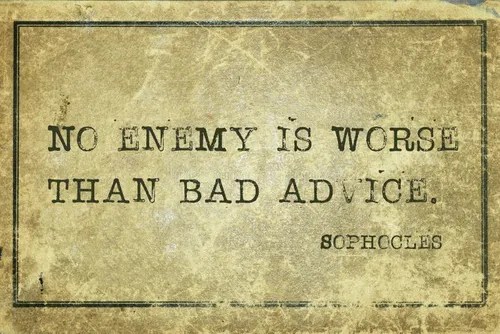
Bad Advice #1: “Follow Your Heart”
This may be one of the most common slogans of our age. Follow your heart. Follow your passion. Do what makes you happy.
It sounds uplifting and freeing. Yet Scripture paints a far more sober picture of the human heart.
The Bible tells us:
“The heart is deceitful above all things, and desperately sick; who can understand it?”
— Jeremiah 17:9
And Proverbs exhorts us to:
“Keep your heart with all vigilance.”
— Proverbs 4:23
Why would Scripture command us to guard our hearts if our hearts were naturally trustworthy? The answer is simple: because our hearts can be misled, manipulated, and corrupted by sin.
It is unpopular to say this but because of original sin, because of sin, we cannot trust our hearts
Because of original sin, the human heart is not a flawless compass. At times our desires are selfish, impulsive, or short-sighted. Many disastrous decisions have been justified simply because someone “felt” it was right.
People plunge into crushing debt chasing dreams they never carefully counted the cost for. Relationships collapse because someone believed in their heart they could change another person. Others abandon responsibilities because their heart tells them they need something different, even when there is no plan, no safeguard. Where wisdom would say stay.
Our hearts make poor gods.
Jesus does not tell Thomas to look inward for the answer. He points him to Himself.
“I am the way.”
Christ does not merely give directions; He Himself is the path. He leads us to the Father. He shepherds His people in truth and righteousness.
Scripture also teaches that the Holy Spirit guides believers through the Word of God. The Christian life is not about blindly following feelings but learning to submit our desires to Christ.
Psalm 37:4 is often quoted:
“Delight yourself in the Lord, and he will give you the desires of your heart.”
But notice the order. The promise is not that God exists to fulfill every earthly desire we already possess. Rather, as we delight ourselves in the Lord, He reshapes our desires to align with His will.
When Christ becomes our treasure, our hearts begin to desire what He desires.
Jesus does not say follow your heart, but follow Him, be led by the Holy Spirit.
Bad Advice #2: “Live Your Truth”
Another common phrase today is: “Speak your truth.” The idea sounds compassionate and liberating, but beneath it lies a dangerous assumption — that truth is subjective and personal.
But truth cannot simply be whatever each person wants it to be.
Gravity does not cease to exist because someone rejects it. Financial realities do not change because someone dislikes mathematics. Moral truth does not disappear because society grows uncomfortable with it.
If truth is entirely personal, then what happens when truths collide?
One person’s “truth” may justify hatred, exploitation, or injustice. Another’s may contradict it completely. Without an objective standard outside ourselves, truth becomes nothing more than power, preference or opinion.
Scripture presents a radically different foundation.
Jesus does not say He speaks a truth. He says:
“I am the truth.”
Truth is grounded in the very character of God Himself. His Word is unchanging, eternal, and trustworthy.
This is why societies flourish when built upon moral truths that reflect God’s law: do not murder, do not steal, do not bear false witness, love your neighbor, pursue justice.
Our culture often celebrates self-definition while simultaneously contradicting itself. We are told that people are “born this way” in one moment, while in the next we are told human nature itself is entirely fluid and self-determined.
One minute we are born this way and you must accept and affirm me and at the same time I am born this way, I don’t like it, you have to accept and affirm my choice to change how I was born
Again, we go from born this way I can’t change to born this way let me change.
Which is it?
What if I am a deviant and I can’t help myself. I am born this way? Am I left alone or am I to seek treatment and rehabilitation?
Such confusion reveals what happens when truth is disconnected from God.
It is shaky ground when we look inward to define reality. We must look outside of ourselves, upward to the One who created reality.
“We hold these truths to be self-evident, that all men are created equal, that they are endowed by their Creator with certain unalienable Rights, that among these are Life, Liberty and the pursuit of Happiness.”
So are there God given rights that every human has, or are they given to use by our government or community which means they can be taken away
And if your government says its ok to marry children but mine says it is not. Who is right?
We do not need our truth, but the truth.
Bad Advice #3: “It’s My Life”
Modern culture prizes autonomy above nearly everything else. We are told our lives belong entirely to us and that we alone determine their purpose and value.
But Scripture asks a deeper question:
Who gave us life in the first place?
If God is the Creator, then life is not ultimately ours to define or discard at will. Human dignity does not come from accomplishments, productivity, intelligence, independence, or usefulness. It comes from being made in the image of God.
This truth has profound implications.
A child with severe disabilities possesses the same God-given dignity as a successful businessman. The elderly person suffering with illness is no less valuable than the young and healthy. The unborn child is not a “potential” human life but a human life with potential. It has all the genetics and DNA of a human and is deserving of human, God given rights,
Who gets to decide whose life is worth preserving? And why them and not someone else.
Why not a committee of doctors, or lawyers or philosophers?
Once society begins defining which lives are valuable and which are not, we enter dangerous territory. History repeatedly shows us where that path leads.
Christians affirm the sanctity of life because life belongs to God.
Jesus says:
“I am the life.”
Life is not merely biological existence. True life is found in Him. He is both the author of life and the giver of eternal life.
I recently heard a challenge to turning back immigrants saying we could be turning away the doctor who could cure cancer. We could say the same thing when it comes to abortion or assisted suicide.
The Scriptures tell us our times are in His hands. Nothing surprises Him. Nothing falls outside His sovereign care. He knows the beginning from the end.
Psalm 139 goes to lengths to say God knows my comings and goings, words I speak all about me. Then in verse 6 says For you formed my inward parts; you knitted me together in my mother’s womb. 14 I praise you, for I am fearfully and wonderfully made. Wonderful are your works; my soul knows it very well. [2]
And remarkably, Christ does not simply offer advice for living, reaching your potential, living your best life now.
He offers Himself.
Christ Is Better Than Cultural Slogans
The world offers shallow slogans that sound comforting but cannot bear the weight of real life.
Follow your heart.
Live your truth.
It’s your life.
Yet each one ultimately turns us inward, making self the center.
Jesus redirects us away from ourselves and toward Him.
He is:
- The Way — the One who reconciles sinners to the Father and guides His people in righteousness. Who shows us how to get to the Father
- The Truth — the unchanging standard in a world of confusion.
- The Life — the source of both physical life and eternal life.
This does not mean Christ tells us every small detail of our future. He may not tell you what house to buy, what town to live in, or which career to pursue. But He does teach you how to live faithfully wherever He places you.
The Christian life is ultimately simple, though not easy:
To love the Lord your God with all your heart, soul, mind, and strength, and to love your neighbor as yourself.
When we trust in Christ, delight in Him, and walk in His ways, we begin to see life rightly. Our desires are reshaped. Our understanding becomes clearer. Our lives begin to reflect His goodness.
Not because we found ourselves.
But because we found Him.
[1] The Holy Bible: English Standard Version (Jn 14:1–7). (2025). Crossway Bibles.
[2] The Holy Bible: English Standard Version (Ps 139:13–14). (2025). Crossway Bibles.
 Common Man Faith